Sunday, September 26, 2010

sunday drive: the metro stop

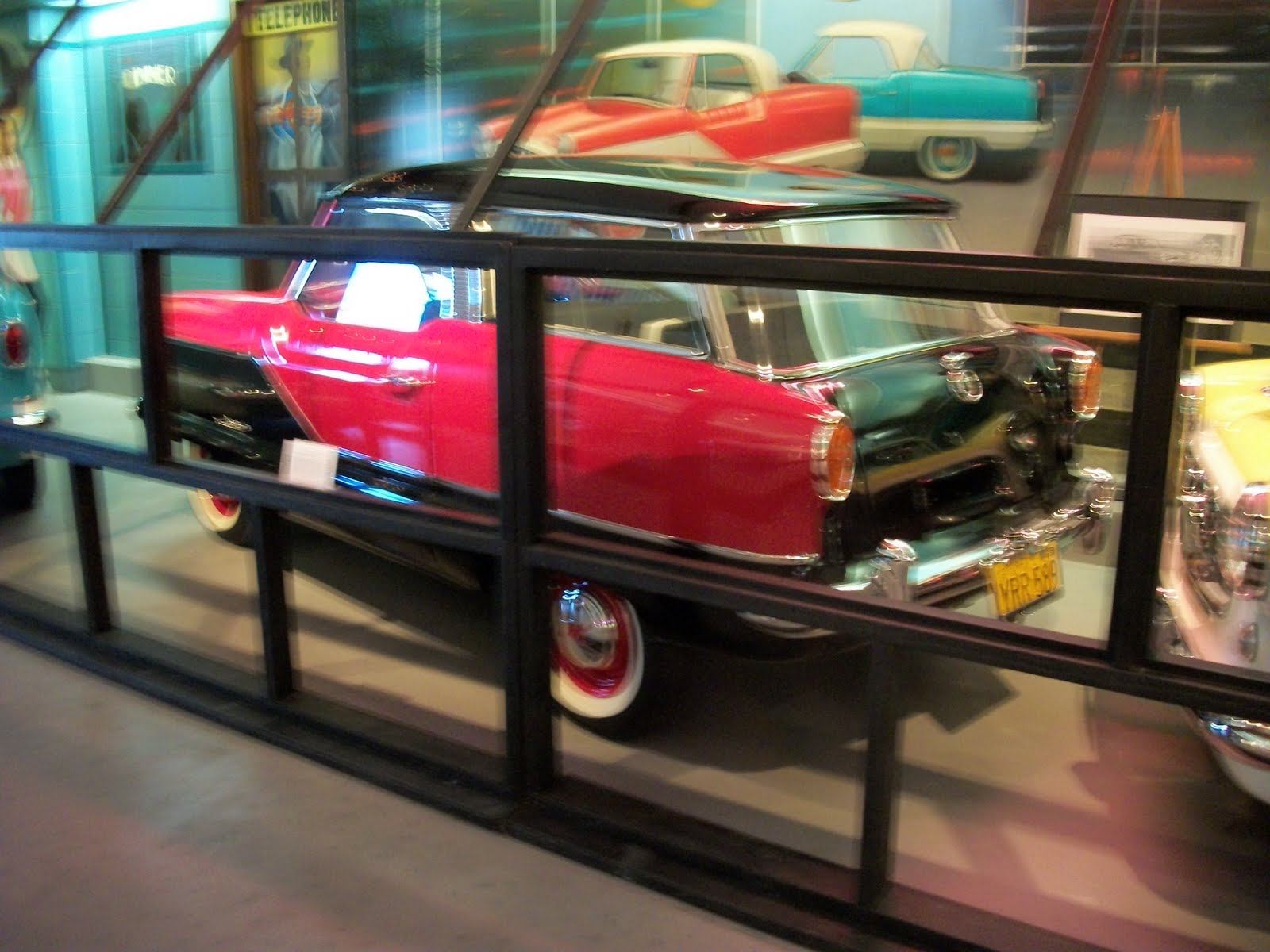
An accidental happening. Much like Gulliver dropping in on the Liliputians, I didn't anticipate this encounter. If I had, I would have brought my good camera along. I was helping a client drop off his cute little '60 Metropolitan at a repair shop in the Valley which specialized in them. Seemed harmless enough.

And that's how I found the Metro Stop. Founded by Jimmy Valentine in 1975, it's a repair shop all right, and a showroom, and a museum highlighting the rarest and most unusual Metropolitans ever made. Several prototypes and show cars- A super early NKI convertible, the dressed up pearl white Westerner show car, a one off wagon prototype, a RHD Metro, a Hudson Metro, and even the only Metropolitan fire truck. Tons of memorabilia and Metro murals. And even the Astra Gnome, a one off failed attempt to not only bring the space ship down to earth, but also to mount it on a Metropolitan as well.

A family affair since the beginning, it's presently operated by Jimmy's daughter June. And if you're a fan of the Met, it's a must visit. Next time you're in North Hollywood, stop by and check it out.

But until then, take a look at the Metro Stop:


View their website here


And see kicky video of the Astra Gnome here:

Friday, September 24, 2010

2011 nissan juke: the serious toy car


It's hard to believe the whole toy car era is almost 20 years old now. It was 1991 when Nissan introduced the Figaro, a limited production home market only job with the look of a cartoonized fifties french runabout. It sold out instantly, with dealers holding a lottery to see who would win the right to buy one. It became an instant collectible, and inspired other vehicles whose design seemed to either look directly in the rearview mirror, toward the appliances on the kitchen counter, or above all to value whimsy over function.

Volkswagen brought out their Retro Concept One which came to market as the New Beetle. Ford took the license to bring out retro version of anything that had sold more than a few thousand copies in the first place, with Retro Birds and Retro- 'Stangs. Chrysler corporation brought out a pair of cars to market in the Plymouth Prowler and PT Cruiser which, in case everyone else missed it, looked MUCH more like miniature '37 Fords than anything the blue oval itself ever created. The trend created variants, with the Scion xB bringing the chest freezer to the automotive showroom, the Nissan Cube paying homage to the Flashcube, and the Kia Soul demonstrating that the paralleologram isn't just for geometry class anymore. All are highly styled products based on existing platforms for cost effectiveness.

But the new Nissan Juke refines the game. Call it Toy Car 2.0, or the Toy Car goes to College, because the Juke combines whimsical styling with a very sophisticated little chassis and a level of content and sophistication heretofore unseen in whimsical motoring.

The Juke is scheduled for introduction in the fall and is based on the Nissan B platform (think Versa) but with completely unique styling. Juke comes in one style, a four door hatchback.The overall profile is that of an exaggerated leaf, with the same contours applied on a smaller scale, with greatly enlarged wheel openings. The overall roof shape is similar, but the Juke conceals the rear door handles for a coupe look. The Nissan Z-car trademark boomerang taillamps are utilized, but they race up the C pillars. And the front end styling sets off the whole car- I find it rather froglike, if frogs happened to have parking lamps for eyebrows. Overall very fun and whimsical, definitely youthful, but beautifully executed. I for one found the parking lamps (bi-directional and visible from the driver' seat) to be a work of art.

Similar sophistication was evident in the chassis as well. While based on the B-platform. the wheels were pushed out for a wider stance and greater stability. This track of 60.0 inches from and rear with a wheelbase of 99 inches creates a large footprint creates the basis of a very stable chassis with handling characteristics of a much larger vehicle. The standard powertain is a 1.6 liter four cylinder engine featuring direct injection and a turbocharger. It develops 188 hp and 177 lb.ft of torque, but notable has a broad torque curve. It's mated with a standard 6 speed manual transmission and front wheel drive. A CVT automatic transmission is optional, and Nissan's Advanced Torque Vectoring AWD is available with automatic transmission only. This system splits torque not only front to rear, but also side to side across the rear axle. It marks the smallest chassis Nissan offers an AWD system on and incidentally adds only 64 pounds to the vehicle's weight. In addition, AWD cars will come with a rear multilink suspension with a stabilizer instead of a rear torsion bar setup. ABS, front disc brakes and Vehicle Dynamic Control (with traction control) are standard, as are 17" allow wheels and all season tires.

Nissan has positioned the Juke with three trim levels and a high level of standard content. All models have the 1.6 turbo engine, 17" alloy wheels. iPod connector and Bluetooth, remote keyless entry and speed sensitive electric power steering as standard. they all have 6 air bags and active headrests as well. The mid range SV adds intelligent key, XM radio, auto climate control, power moonroof and upgraded cloth. The top of the line SL adds leather seating, heated front seats, standard navigation (optional on other models at $500) upgraded audio and a rear view monitor.
Manual transmission is available on S and SV only, and AWD is offered on all three models. Pricing is expected to range from a base S CVT at $18,960 to a fully equipped SL CVT AWD at $24,550.

We spent a day driving the Juke along the picturesque Sunshine Coast of British Columbia on a later summer day. I sampled the SV AWD and the S FWD, both with automatic transmissions. Both cars impressed me a lot- the smooth powertrain with no noticeable turbo lag and a very even torque curve, a CVT so responsive it even has shift points, an excellent seating position and a great, surefooted feeling, owing both to the wide stance and to Nissan's electric power steering, which offered considerably more road feedback on the twisty rural roads than other systems I have sampled. By far and away I preferred the AWD, both for the better ride resulting from the multilink suspension and for the extra torque from the Torque Vectored AWD. It was instantly noticeable when I pulled away in the AWD version. Kudos also to Nissan's "low cost" Navigation- at roughly $500, it's a simplified but effective Nav system which omits the fancy features I never learned to use on my STS anyway but gives you what you need for $500.

It may well be that the appeal of this car is going to come down to the styling. If you like the whimsical look, there's an excellent car beneath that will deliver great economy, road comfort and some pretty impressive handling characteristics (especially with the AWD) and a terrific parkable city size. My biggest down side with the exterior is the relatively drab color palate - only a blue and a red in a sea of grey metallics. A Look At Me car in a dull color is like Britney Spears in sweats driving a Camry, and this car simply screams for some seventies colors- a bright yellow, lime or metallic orange.

So call me when the Lime Green ones come in.


Saturday, September 4, 2010

The Edsel- Ford's Murder Victim


Labor Day 1957- The Russians announced that their Intercontinental Ballistic R-7 Missile could reach the west. The report of a successful test flight was announced on August 26 and dominated the news headlines of the week, until September 4th when the Americans announced their own bomb. It was called "the Edsel." and it the day chosen for its introduction was designated as "E-Day."

The Edsel, a medium priced car offered in four series, was positioned between the Ford and the Mercury on the Ford ladder. Its lower priced series were based on Ford, the upper series based on Mercury. It was the most researched car in Ford's history. And it was a thundering flop that lived only three model years.

Many post mortems have been performed on the ill fated Edsel and blame has been assessed: the controversial styling, the inexperienced dealer body, production snafus and the deep postwar recession. All are certainly factors, and had a role in the ultimate failure of the marque. But there's even more to the story.

The Edsel arose out of a concept known as the Breech Plan. It was conceived by Ford executive Ernest Breech, who was one of Henry Ford II's "Whiz Kids" who were brought in to save the company after the death of its founder in 1946. Breech had a reputation of being a trouble shooter and strategist, and he felt that Ford was missing too many segments of the market uncovered. He was a close friend of Henry II and it was not a surprise when Breech was named Chairman of the Board in 1955.

The Breech plan called for an alignment along the lines of General Motors- the Low priced Ford, a low-mid priced offering, the Mercury (migrating somewhat upmarket), the Lincoln, and a Super Lincoln. The board approved the plan in 1955, and of course the new low-mid priced offering ultimately became the star crossed Edsel.

Robert S. Macnamara was another of Henry Ford II's "Whiz Kids", who were brought in to save the company after the death of Henry. Macnamara was a Harvard MBA accountant whose expertise in cost management brought him huge accolades and reinforced his power within the ranks. And he strongly opposed the Breech Plan and the Edsel. Macnamara felt that the Ford Motor Company should concentrate on maximizing volume on the Ford nameplate (upon whose sales he just happened to be paid) and opposed the Edsel whose success he saw as distracting from his livelihood.

He was powerful enemy who made his displeasure known to all within earshot, both inside and outside of the company. Fairfax Cone, president of the Edsel's Advertising Agency wrote in his memoir that while in detroit for the Edsel's launch, he asked Macnamara what he thought of the yet-to-be-introduced new car. He wrote that he was shocked that Macnamara's response was "I have plans for phasing it out."

One cannot downplay the importance of such a powerful opponent. In the early fall of 1957, when Edsel was hoping for a strong launch, Macnamara offered strong dealer cash incentives of up to $750 on Ford cars, making the Edsel effectively $1000 more than a Ford. He succeeded in getting the Mercury, Edsel and Lincoln divisions merged and from there steered the downfall of the brand- first with consolidating Edsel products onto the Ford chassis only for 1959, and then reducing the make to a very slightly differentiated Ford for 1960.

Of course there were many factors going on in the market place in the late 1950's. The economy was in a deep recession. The controversial styling was a factor, but a similar look had given Studebaker record sales a few years back. Production quality was spotty. Dealer discounts on Fords made Edsel intenders into Ford drivers. And once the first comedian referred to the car as an "Olds sucking a lemon", the carefully crafted image began to shake.

First year Edsel sales of 61,000 were well below expectations, yet nonetheless represented the second best new nameplate introduction up to that time. But Macnamara was harping daily on what a disaster it was and now it needed to be dropped, and support within the company for the Edsel eroded daily. Edsel found its budgets slashed, its staffs reduced, and its options severely limited.


On November 14, 1959, Edsel became Ford's first murder victim.

Friday, August 27, 2010

Couture Cars: Designer Wheels and Special Editions of the 70’s-

by Jeff Stork

Part II of the series. For Part I, go here.


High Gear


It all broke loose in 1976. Ford took the driver’s seat with the debut of the Continental Mark IV Designer Series. Four distinctive models, each with its own color scheme, designer identification, and distinctive special features chosen by a prominent designer: the Cartier Edition in triple pearl gray, the Bill Blass in Navy Blue and Cream, the Givenchy in Pale Turquoise accented with White, and the Emilio Pucci in Maroon with a silver landau top and Pucci fabric on the sunvisors. Each included alloy wheels, landau tops, and ultra plush velour interiors as standard with leather as a delete option. And each were very pricey- $2000 with velour or $1500 with leather. Yes, probably the first time in history where leather was a credit option. Very profitable, popular and prestigious entries, they accounted for 27% of Mark IV sales that year.


Other manufacturers noticed and the popularity of special models increased. Cadillac went for the velvet rope of exclusivity and produced exactly 200 identical Eldorado Bicentennial convertibles, with identical color schemes and dash plaques, and launching a specially trimmed Eldorado Biarritz coupe at mid-year.


Sporty Pontiac released a limited edition Trans Am SE, in black with gold pinstriping and trim, which was warmly received but would later become a sensation when a certain Burt Reynolds film was released. And sadly, the company that started it all seemed to back off at this point, as the Cassini Matador was replaced by a trim level called Barcelona, and the Cardin and Gucci were long gone, although the popular Levi’s editions would remain.


Ford shifted into high gear in 1977 and never looked back. The Continental designer series were totally revamped to suit the new Mark V. Cartier retained its cool and elegant triple Dove Gray look, The Bill Blass was newly suited in Navy Blue and Chamois Orange, including a Chamois landau top and special pigskin grained chamois leather. Givenchy got a completely new look in Midnight Jade with a Chamois forward roof section and Emilio Pucci started the year with a black and white ensemble of black paint, white landau and white leather interior. Pucci was always a limited demand item, but when the Adam-12 look failed to inspire it was replaced with Navy and Dove Gray at midyear. Such is the prerogative of fashion. The new styling and the Designer Series were a smash hit together- Continental sales hit 80,000 units and a large and very profitable percentage of them were Designer Series models.


The big news at General Motors was tiny indeed. The Chevette Sandpiper, in Cream Gold with triple yellow striped reef cloth interior (including yellow dash pad, headliner and carpeting) and special Sandpiper decals on its rear fenders marked the smallest special edition out of Motown. It sold in appropriately tiny numbers and was not continued. But the Trans Am SE went stratospheric, having been featured in Smokey and The Bandit. It soon became known as the Bandit T/A.

AMC, the little car company who so often couldn't, made one more stab at the market with the Matador Barcelona II Coupe. It featured two tone paint, a padded landau roof, stand up hood ornament and even body colored bumpers. This one deserves a video- have a look


Next- Part III- Winding Down

Thursday, August 26, 2010

chevy cruze: is it chevy's jan brady?


I spent some time last week in Washington DC with an all new Chevy compact sedan. No, not the Volt- the other one. The Cruze. C-r-u-z-e. No, I know you haven't heard of the name. It's new. In fact, It's an all new product which will be sold globally under the Cruze name, replacing a patchwork of different nameplates.

It's based on the front drive GM Delta II platform (same as that attention grabbing Volt) and will be produced in several countries, with the North American Chevrolet version coming from the retooled Lordstown, Ohio plant. Cruze will go on sale in the third quarter of 2010.

The Cruze will offer many choices- perhaps too many. Five different models- one more and they'd tie the Brady Bunch. And there really is a sixth because the much touted Volt is based on the same Delta II platform, which makes the whole Brady analogy totally fit. The Cruze is the Jan Brady of Chevy.

And it all makes sense, With the Volt wearing the Marcia Marcia Marcia "Look at Me" crown, the capable and competent Cruze is Jan- second fiddle to her more newsworthy and headline grabbing sister, but for many, many people a much better choice based on sound technology and superior affordability. And while the Doug Simpsons of the world may line up to spend $35,000 plus for the Volt, the George Glasses will probably be getting the better deal. I suspect in the long run, Jan will eclipse Marcia's popularity.


Cruze trim levels range from the Cruze LS at $16,995 base through the slightly more stylish Cruze LT with the 1.4T and alloys at $18,895, the LT2 adds leather leather, bluetooth, USB and more a $21,395 and for those who demand it all, the Diana Ross of Cruze is the LTZ with auto climate control, parking assist, 18" alloys and four wheels discs at $22,695. And for those who really need to channel their inner Diva, the RS appearance adds lower body fascia wrap, fog lamps and spolier to any LT or LTZ for $695. And for those Al Gore supporters, there's the $18,895 ECO with a standard six speed stick and expected 40 mpg EPA highway fuel economy.

I wouldn't say that the styling screams "Chevrolet!", keeping in mind the global intentions, but it is clean and contemporary, with the signature bisected Chevrolet Grill up front and gold bowtie badge flanked by jeweled headlamps. The sides are clean, and the roofline tapers smoothly rearward. The car features a wide stance and the wheels seems to fill up the wheel wells nicely (standard size is 16"), especially with the optional 17"s and 18"s. After all, bigger is better up to a point. Wheels. We're talking wheels here. The rear seems the least distinctive part of the style, again cleanly styled but didn't seem to speak any specific brand character. However, one must note that the styling of its Cobalt predecessor screamed "rental", so please don't think I was displeased with the new look at all. Clean and contemporary, and light years ahead of some of the entries of the recent past. Besides, Jan looked nice but Marcia was the glamour girl.

A big change one I climbed inside. Gone was the one piece molded door panel and black plastic everything you touch. The interior has a two toned theme on the dash and door panels, the materials are a HUGE (that word again!) improvement with soft touch dash facing and the current GM HVAC and audio controls which are very nice and tactile. The optional Navigation system (which I did sample) integrates nicely into the display, although I found the map a bit small. Still this is a Cavalier successor, and we're discussing the Navi screen. That's called progress. Speaking of progress, comfortable and well tailored seats. Ahhhh. Much nicer than the Chevy compacts I remember. Overall impression is very comparable to the Buick Regal I drove last month (and liked) although slightly smaller in scale.

Power for most Cruze models comes from the new Ecotec 1.4 Litre Turbo with variable valve timing, which produces 138 hp and 148 lb/ft of torque, mated to either a six speed manual or six speed automatic transmission. In the Cruise Eco variant, the car is expected to deliver 40mpg highway, with other versions likely achieving mid-thirties. The 1.4 Turbo is fitted to LT, LTZ and ECO models. The base LS utilizes a 1.8 litre conventionally aspirated engine developing 136 hp, and 123 lb/ft of torque. We did not drive that particular configuration.

The Chevy folks took time to point out the many safety features of their newest compact, including ten air bags (two front, two head curtain, four seat mounted side impact, and two front knee bags) along with collapsible pedals (yay!) stabilitrak electronic stability control and a bunch of GM favorites like Tire Pressure Monitoring, DRL's and automatic headlamps. Additionally, about 65% of the body is made of high strength steel and GM anticipates that the car will achieve five star crash ratings in every country in which it is sold, so it should be up to the rigors of Jan's paper route.

Driving impressions come from a day on twisty rural roads in suburban Virginia. I drove a targeted variety of Cruze models, those being an LTZ with Nav and one without. So I'm an option Queen. I admit it. But at least I mixed up the colors.

The 1.4 litre turbo 4 cylinder is silky smooth at idle and pairs well with the six speed automatic transmission. Acceleration is smart and shifts are smooth. we're light years ahead of the Cobalt and Cavalier. The ride is smooth and controlled, and I far preferred it to the Corolla S which was provided for comparison. Interior materials were much nicer as well. I especially liked the soft touch dash and the door panels which are much more substantial feeling than the Toyota or the Cobalt. We were also provided with a Civic sedan for comparison, and it had a ride and handling more on par with the Cruze, but I can't get used to the Star wars instrument panel and the A-pillars that seem to me modeled after the old Gm Dustbuster minivans. The little Chevy held its head high against the gold standard of the compact class, and that is simply something I've never been able to say before.

Jan Brady for Class President! Now what will they do for Cindy?

Sunday, August 22, 2010

sunday driver: amc matador barcelona

There on the field at Motown 2010, surrounded by over 220 fascinating and unusual cars, cars with fabulous design, incredible color, loving restoration, and impeccible provenance. How could one possibly choose a favorite?

And then I saw IT.

It must have known of my unabashed love for weakly branded products, of my glee upon seeing a botched facelift, my delight in watching the overmarketing of what was had been, in fact, a most plebian chariot.

I've already written about the exciting Oleg Cassini Matador Coupe, how AMC slapped a few logos and some copper paint on a Matador Coupe in an attempt to cash in on the cache of a designer label. Well as time passed they cut Oleg out of the deal to save on coin, and created the Barcelona Matador, and the really wild Barcelona II, with a landau top and painted bumpers.

And for 1978, they decided the world needed a Barcelona SEDAN. Yes, the lowly sedan, fresh from service on Adam 12, fitted with cow catcher bumpers and a coffin nose, became the basis of the overpimped Barcelona package. Same Golden Ginger Metallic over Sand Tan color scheme. Same woodgrained gauge faces. Same individual comfort lounge seats in velveteen crush fabricx with woven accent stripes, same grain on the vinyl roof, same two-toned sport wheels and an absolutely wild two tone pattern which bears no more relation to the lines of the car than the safety bumpers did. Special Barcelona insignias and hood ornament set off the look. AMC emblems proudly affixed front and rear, but who needs them- who ELSE would have made this car?

Barcelona- Because Spain is EXACTLY like that.


Monday, August 16, 2010

rides of the king

How else would a gearhead mark the anniversary of Elvis Presley's passing than by taking a look at some of the fabulous cars he owned? Elvis loved cars and bought them on a whim, sometimes for strangers. He is famous for buying his mother a pink Cadillac, but preferred black and white for himself. In his own stable, Cadillacs and Lincolns dominated- mostly Cadillacs in number and Elvis and Cadillac are linked in the minds of many, but his favorite car in the '50's was his 1956 Continental Mark II and in the seventies, the King also loved him some Stutz Blackhawk. In fact, the last photo taken of him was driving his beloved black Stutz. So on the thirty third anniversary of his passing, remember the King via some of his coolest rides.

Driving his yellow 1955 Cadillac:

The 1955 Fleetwood purchased by Elvis for his mother, Gladys Presley:


Elvis and his white 1956 Continental Mark II:


Elvis' $100,000 1960 Cadillac Limousine, customized by Barris:


Another Barris Custom, Elvis' 1965 Cadillac Eldorado convertible:


Elvis and two of his Stutz Blackhawks, the white 1972 and the black 1973:


The last car purchased, his 1977 Seville, at Graceland and being driven:


Another pose of the 1977 Seville:


The last known photo of Elvis- Aug. 16, 1977 at 12:28 AM, returning home in the Stutz Blackhawk:


Elvis's funeral procession- the 1977 Cadillac hearse and parade of white 1977 Cadillacs: